

The Newars associated with the famous cultural festival called Indrajatra call it Yaya in the Newar language. It is called Indrajatra only when speaking to other communities, while the name Yaya is usually used when speaking among themselves. Indrajatra is a foreign or imposed word. The three districts of Kathmandu, Lalitpur and Bhaktapur in the valley also have their own names in the local languages - Ye, Yal and Khwap. The festival is called Yaya. In the meaning of the festival of Kathmandu, that is, in the meaning of 'Ye' as 'Yah', this festival is called 'Ye'ya'. But in the overall Newar dialect, the word 'Ye'ya' is not used but 'Ye'ya'. The difference between the two words 'Ye'ya' and 'Ye'ya' sheds light on many things, i.e. Ye'ya' means the festival of Kathmandu, while Yaya' means a cultural festival. Since Yanya is a cultural festival celebrated not only in the Kathmandu Valley but also in most Newar settlements in the valley, it is not logical to call it Yanya, i.e. Kathmandu's festival. This is Yanya.
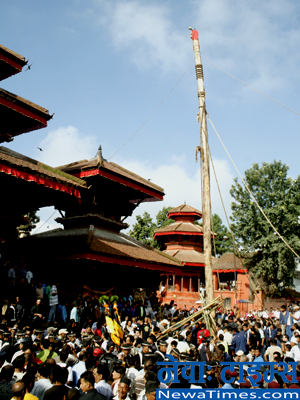
The word Yanya is often mentioned in today's publications as a corruption of Indra Jatra. The argument that the word Indra is 'Yandra' and that Yanya was corrupted to become 'Yen' is actually just a forced argument like a river flowing in the opposite direction. Indra does not have much place in Kathmandu as elsewhere.
Although it is called Indra Jatra, there is no special cultural activity related to Indra on this occasion. At this time, the Yama:dya is kept on public display. The argument that the same 'Yama:dya' is Indra is also not compatible. This argument is based on a story, but that story is not about glorifying Indra but about humiliating him. It is not logical to have a festival in the name of a character who has been humiliating. Indra is presented as a thief in the story. The main source of knowledge about Indra is the Rigveda, such a story is not found in the Rigveda. Although the name is Indrajatra, there is no context related to Indra, so it is wrong to call it Indrajatra. When a separate article of mine was published, it was also found that ‘Indra is worshipped’, but the fact that Indra is worshipped in a few villages does not come into the mainstream of this festival. Rather, other gods and goddesses are worshipped and welcomed on this occasion to a sufficient extent.
What is the relationship of Indra with the Kathmandu Valley? This is a historical question. Indra’s power was in the Vedic period. Indra is the most discussed in the Rigveda. Although Indra’s power was supreme in Vedic society, it did not always remain so. It is found that there was a rebellion against Indra’s power among the Vedic people or that another party gained influence and established the power of Vishnu. The rise and development of the Bhagavata sect within Vedic society is a direct example of this. The Bhagavatas reject Indra and accept the power of Vishnu. The Bhagavata sect is known today as Vaishnavi.
The entry of the Vedics into the Kathmandu Valley was only much later. When the Vedics entered Kathmandu, Indra had already lost his power in Indian territory. It was only many years later that the Vedics entered Nepal. This is why the worship of Indra is almost rare in the Vedic society of India and Nepal. In such a situation, it is not possible to have a procession in the name of the same Indra.
The promotion and grandeur of the Yaya (Indrajatra) culture is more visible in Kathmandu. This is why there is a misconception that it is a Kathmandu procession. The Indrajatra is often used to understand and explain the environment around the Hunmandhoka Durbar area. But its antiquity can be seen in Kilagaal Tole located to the north more than in this area. When we give a culturally nuanced view, the similarity of the scenes seen in Kilagaal Tole on the occasion of Yaya is better seen in Bhaktapur. While Kilagal is a predominantly Jyapu settlement, the villages that celebrate Yaya are mostly Jyapu in Bhaktapur. Although Yaya is exhibited for eight nights and nine days in 21 villages of Bhaktapur, today it has decreased and only about 17 villages remain. The antiquity of Yaya can be seen in Bhaktapur. Apart from Kathmandu and Bhaktapur, Yaya is also practiced in other Newar settlements of the valley. Although Yaya is not celebrated with various activities in those settlements, it is customary to celebrate the festival by saying ‘Samebaji Punhi’ on the day of the full moon and distributing Samebaji.
Gautam Bajra Bajracharya, who is studying the culture of the pre-Vedic period, has also focused on the Yaya festival. According to him, Yaya is a ‘pre-monsoon culture’ and is related to the pre-Vedic culture. That is, long before the Rigveda, which lists Vedic gods including Indra, was written, a culture like Yaya had come into vogue in this region and it has continued to the present. In this sense, even before the Vedic civilization entered the Indian territory from elsewhere, there was a different culture and civilization in this region, and it can be said that the work of continuing it was done by the Newar community. Yaya started being called Indrajatra only much later. Or it can be said that outsiders, by weaving some stories and making new interpretations, affected the history and tradition of the ancient Yaya culture, and started calling it Indrajatra and Vedic festivals, but only the name changed, the culture did not change. Probably, Yaya originated in Bhaktapur and reached Kathmandu from there in the process of expansion. When it reached Kathmandu, many elements of the festival were added to it, but its originality remained. In other words, Yaya is the primitive culture of Kathmandu, and it exists as a common culture at present.

More from Basanta Maharjan


Comments (5)
२. ञलायाः अर्थात ञयाः र येंयाः एउटै पर्व होइनन्, एकै समय परेको संयोग मात्र हो ।
३. ञलापुन्हि सबै पुरानो नेवार बस्तीमा मनाइन्छ, येंयाः येंदेमा मात्र मनाइन्छ ।
४. येंयाः र इन्द्रजात्रा फरक पर्व हुन् । येंयाः र इन्द्रजात्रा एकै अवधिमा पर्नु संयोग मात्र हो ।
५. येंयाः येंदेमा मात्र मनाइन्छ, इन्द्रजात्रा पुराना नेवा बस्ती सबै ठाउंमा मनाइन्छ ।
६. इन्द्रजात्रा भनेको चोरीको दोषमा इन्द्रलाई बेइज्जत गरी सजाय दिइने पर्व हो ।
७. चोर इन्द्रलाई चौबाटोहरुमा अग्लो मचान वा टांडमा आठ दिनसम्म सिक्रीले बांधेर राखिन्छ ।
८. इन्द्रजात्रामा निकालिने पुलुकिसि इन्द्रको वाहन ऐरावत हात्तीको प्रतिक हो ।
९. पुलुकिसि यताउता उछलकुद गर्ने भनेको उसको मालिक इन्द्रलाई खोजेको अभिनय हो ।
१०. इन्द्रजात्रा र काठमाडौंको कुमारी रथजात्रा पनि एकै समय परेका फरक पर्व हुन् ।
११. इन्द्रजात्रा र ञयाः र येंयाः pre monsoon पर्व होइन post monsoon पर्व हो ।
Write a Comment